The meeting in Moscow was kept secret. The Soviet leadership had agreed to a low key exchange of views with one of the private policy advisers of the UK’s then Prime Minister, Margaret Thatcher.
In 1981, George R. Urban, my father, had been invited to join ‘Thatcher’s private band’ (as The Times put it) to give her direct access to his expertise in communism in all its manifestations; and how best to manage communist regimes. He and a small team went prepared for an ideological tussle, contrasting communism with free-market capitalism, questions of personal freedoms and such attributes of democracy versus command economies and oppressed, fearful citizens.
It was the early 80s, the USSR was the Cold War enemy of the West. My father was known as an intellectual ‘cold war warrior’, as The Times called him, up to and including the flattering obituary they published on his eventual death in October 1997.
‘In his many interviews, seminars and books, he uncovered the true workings of communism,’ wrote The Times in his obituary. He was also a crusader for European unity. The Guardian’s obituary began: ‘In a hypothetical post-communist state of Mitteleuropa there would have been one candidate for Prime Minister, Foreign Secretary and maybe President – George Urban.’
He eventually became disillusioned with Thatcher. He had always been disillusioned by communism, and fled the Soviets soon after they set up camp in Hungary after the war. There followed the thuggish Stalin years of brutal oppression, its horrors documented in retrospect by books and films, forecast in George Orwell’s novel, 1984, and recorded with emotive power in The Gulag Archipelago by Alexander Solzhenitsyn. My own childhood memories are covered by the cloud of communist oppression and fear of the State.
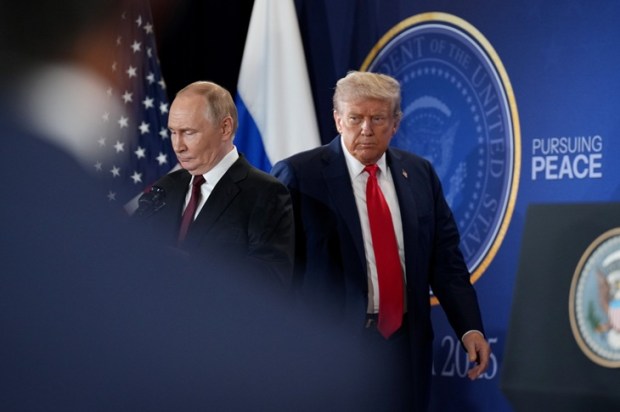
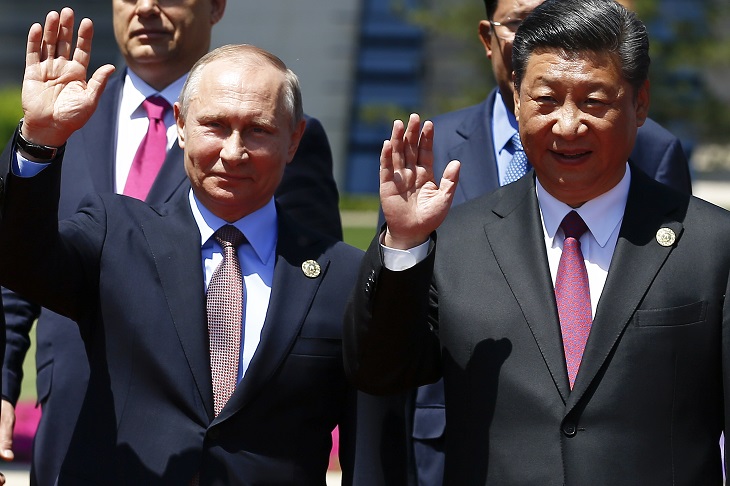
This is the context in which I argue that we can connect the 2022 thuggery of Vladimir Putin in Ukraine to the entire history of communist regimes. From the USSR and now Russia, Cuba to China, from North Korea to Venezuela. When he returned from Moscow, my father explained what he had added to his knowledge about communist leaderships: ‘We expected a robust exchange on ideology and the like … we found a bunch of thugs.’
As is well known, Putin is a former KGB officer. The KGB was the Thug in Chief of the Soviet administration. The KGB template was adopted in all the Soviet satellites, where torture and the threat of it was the primary tool of controlling a population not disposed to communist rule. The misplaced ideological basis for Putin’s behaviour is more complex than that, the brutality justified by a grandiosity of vision, with him at its apex.
What must also be remembered is that members of the secret police were among the elite of the Communist Party, enjoying the many financial and lifestyle benefits that were denied the others. Why this is important is because it provided the strongest motivation for supporting the party line. The higher standard of living in a society where poverty was forever knocking on the door, is a powerful attraction. More so than ideology, comrade.
And therein lies a potent negotiating tool against communist dictators: threaten their perks. Threaten the perks of their inner circle.
Now, Russia’s President Thug is one of the clan, a clan that includes (among others) Lenin, Khrushchev, Castro, Tito, Mao, Maduro, Ho Chi Minh, and the aforementioned Stalin. None of these thugs went hungry when their people did.
The clan has its genesis in Marxism and the birth of communism, when thugs took power by force and kept it by force. That movement was a product of its times. But times have changed. Forced child labour, for example, is no longer a scourge of the capitalist class. ‘Workers unite’ is an obsolete slogan.
These communist leaders are living versions of Animal Farm ‘bosses’, so let’s not be surprised by their violent behaviour, even towards their own people.
As if to demonstrate the accuracy of my father’s observation about the thugs of Moscow, there came the uprising known as The Prague Spring (1968). He wrote about the Prague Spring as ‘a landmark in the history of the world communist movement. Its significance, however, lies not in its short-lived success, but in its suppression.’
Some 30 years prior, there had been the Hungarian Revolution of 1956, which, after its short-lived success, had also been suppressed, also by Soviet force.
China’s ‘boss’ for life Xi Jinping is a communist thug with Chinese characteristics – but equally vulnerable where all such thugs are. In their own family home.
The West must remember that.
Andrew L. Urban is the author of Murder by the Prosecution (Wilkinson Publishing) and edits wrongfulconvictionsreport.org