‘Global heating pushing Australia’s Platypus towards extinction’. So reads a recent headline in Oceanographic magazine reporting a study released by researchers from the University of New South Wales and the University of Melbourne.
Relying on alarming projections of worsening, more frequent droughts, the researchers concluded ‘platypuses face increased local extinctions’, with numbers plummeting by up to 73 per cent.
But then, apocalyptic premises will inevitably result in catastrophic conclusions even when weather patterns are not unprecedented. Indeed, the five worst single years of recorded drought occurred before 1900. And, despite the latest floods, 2021 was only the wettest year since 2010 and, the sixth-wettest year since national records began in 1910. This was well before humans began emitting ‘dangerous levels’ of CO2.
But for catastrophists, if droughts and floods don’t do it, the Bureau of Meteorology’s ‘homogenised’ average land temperatures, which can’t be independently verified, are always a safe bet. They consistently record higher temperatures than more accurate lower-troposphere satellite observations. Satellites have been measuring temperatures since January 1979 and have observed no statistically significant global warming for a decade. No matter. The BoM knows there is a ready market for warming data.
But wait. Haven’t platypuses been around for 16 million years and wouldn’t they have survived more hostile climatic conditions than modern times? And, despite all the panic, isn’t the reality that the actual global rate of temperature increase is about one-third the projected centennial rate?
Still, studies which conclude climate change threats to wildlife survival, not least cuddly koalas, are career enhancing. But, as researcher Maria Nilsson and colleagues at the University of Münster, assert, Australian marsupials have also been around for a long time. They ascribe a migration scenario whereby possibly one group of ancestral South American marsupials migrated across Antarctica to Australia. This occurred prior to the landmasses separating during the warm Cretaceous period, some 80 million years ago when the poles were ice free. Volcanic eruptions and an asteroid put an end to that. Sea levels began to fall and temperatures started to drop. So extreme was the fall in temperatures that dinosaurs became extinct. But not marsupials.
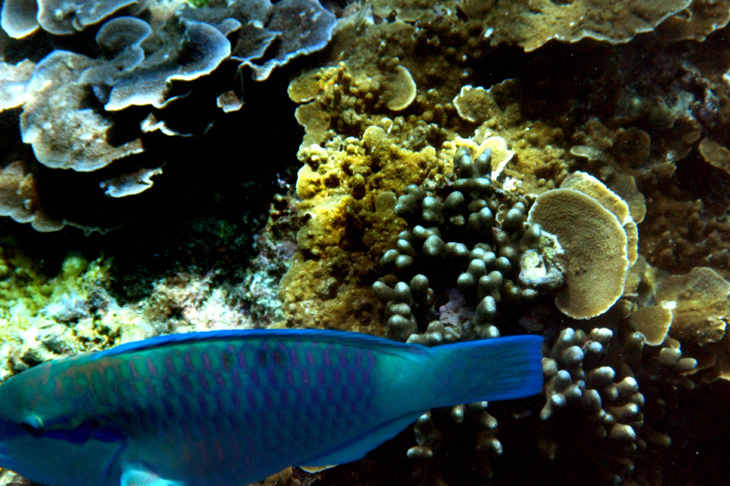
And, it’s not just our fauna. The Great Barrier Reef has been a popular focus of climate catastrophists. Not as ancient as many wildlife species, the reefs have grown on Queensland’s south continental shelf for about two million years and for up to eighteen million years in the north. In their current incarnation they are probably 12,000 years old.
Over their entire existence, sea levels have changed many times. During the last ice age, which began around 2.6 million years ago, the sea level dropped more than 100 metres, making it possible to walk to the outer reef. When the ice age ended around 15,000 years ago, sea levels rose rapidly and new corals grew to form today’s reefs.
Despite this extraordinary record of survival, since the early 1970s activists have been predicting the end of the reef. The latest warning came in a study from James Cook University’s ARC Centre of Excellence for Coral Reef Studies. It claimed the reef had lost more than half of its corals since 1995 due to warmer seas driven by climate change. The study’s lead author predicted ‘The northern Great Barrier Reef will never look quite the same again…. There is no time to lose – we must sharply decrease greenhouse gas emissions ASAP’.
This call to arms was enthusiastically joined by the ultimate global warming cheerleader – the United Nations. It warned that should temperatures reach 1.5 degrees celsius above pre-industrial times, 90 per cent of corals will be wiped out. It called for the reef to be put on a list of world heritage sites that are ‘in danger’. Its Unesco agency lectured Australia to take ‘decisive and immediate action to mitigate the impacts of climate change’. Both JCU and the UN seem ignorant of the fact that Australia already spends per capita ten times more on renewable energy than the world average and four time more than China, Europe, the United States and Japan. And by making Australia a convenient scapegoat, they cravenly avoid exposing the real villain – Beijing, whose emissions in the last decade alone have grown by 25 per cent and now exceed all developed countries combined, almost matching them on a per capita basis.
Which makes the latest Australian Institute of Marine Science annual report proving coral coverage on the northern and central parts of the Great Barrier Reef is at its highest level since monitoring began 36 years ago especially unwelcome. It validates Dr Peter Ridd’s views whose scholarship countering the prevailing apocalyptic orthodoxy, had him fired from JCU.
That said, while the results are reliable, AIMS’s methods are outdated, which raises questions as to why, with $1.44 billion in government grants and pledges, the Great Barrier Reef Foundation has not funded AIMS into the latest Japanese technology? Perhaps in ignorance lies financial bliss? True or not, blaming global warming for the projected decimation of the platypus, certain marsupial populations and, the Great Barrier Reef, has proven to be a lucrative source of funding for activists and rent-seekers. It’s also an excuse for the federal government to institutionalise massive wealth transfers through a 43 per cent 2030 emissions reduction target. It knows this ambition is utterly unattainable but that a lie told often enough becomes the truth. So the enforced economic and social distortions which follow will enrich the few at the expense of the many and be justified on the familiar, yet dishonest, ground that the cost of emissions reduction is far less than the damages of inaction.
As US House Speaker, Nancy Pelosi neatly summarised when supporting the Democrats’ historic climate bill, ‘How can they (Republicans) vote against the planet? Mother Earth gets angry from time to time and this legislation will help us address all of that’. In a world led by superstitious authoritarians, who will argue?
Got something to add? Join the discussion and comment below.
You might disagree with half of it, but you’ll enjoy reading all of it. Try your first month for free, then just $2 a week for the remainder of your first year.